

Created to Cultivate
Human beings were created by God to cultivate - to actively steward, nurture, and develop the life and environments entrusted to them. From the very beginning of Scripture, God establishes cultivation as a central part of humanity’s calling. In Genesis 1:28, God blesses the first man and woman and commands them to “be fruitful and increase in number; fill the earth and subdue it.” Shortly after, Genesis 2:15 describes God placing Adam in the garden “to work it and keep it.” The essence of this language is “to tend and care” for it. Together, these passages reveal that humanity was created to cultivate - both the earth and the life that would fill it.
Within this shared calling, men and women participate in cultivation in distinct ways. The man is primarily tasked with cultivating the ground - working, protecting, and stewarding the environment in which life can flourish. The woman participates in cultivation most directly through fruitfulness and multiplication, bearing and nurturing life itself. Together, husband and wife participate in God’s design for expanding and sustaining life in the world. And in the flourishing of that which they cultivate, they too would flourish.
Cultivation Will Be Hard
However, in Genesis 3 God’s created order to of cultivation becomes corrupted by the curse of sin. In part, the partaking of the fruit of the tree they must not eat from, humanity sought to find substance and fulfillment and flourishing outside of God’s created order.
Genesis 3:16-19
16 To the woman he said, “I will make your pains in childbearing very severe; with painful labor you will give birth to children. Your desire will be for your husband, and he will rule over you.”
17 To Adam he said, “Because you listened to your wife and ate fruit from the tree about which I commanded you, ‘You must not eat from it,’ “Cursed is the ground because of you; through painful toil you will eat food from it all the days of your life. 18 It will produce thorns and thistles for you, and you will eat the plants of the field. 19 By the sweat of your brow you will eat your food until you return to the ground, since from it you were taken; for dust you are and to dust you will return.”
When humanity rebelled against God in the Garden, the consequences of sin fell directly on the very places where men and women were meant to cultivate and flourish the most. For the woman, the curse intensifies pain in childbearing. The place where life was meant to flourish - fruitfulness and multiplication - becomes marked by suffering and conflict. For the man, the ground itself becomes cursed, making the work of cultivating the soil difficult and exhausting. Thorns, sweat, and toil replace the ease and joy of the original calling.
In this way, the curse does not introduce new responsibilities; rather, it distorts the very work humanity was created to do. The man continues to cultivate the ground, but now through hardship. That which he works to cultivate will now work against him. The woman continues to bring forth life, but now through pain. What was designed to be life-giving work becomes difficult and contested. That which she works to cultivate will now work against her. Cultivation will be hard - a poignant reminder that the world is not as it should be.
The Effects of the Curse on Marriage
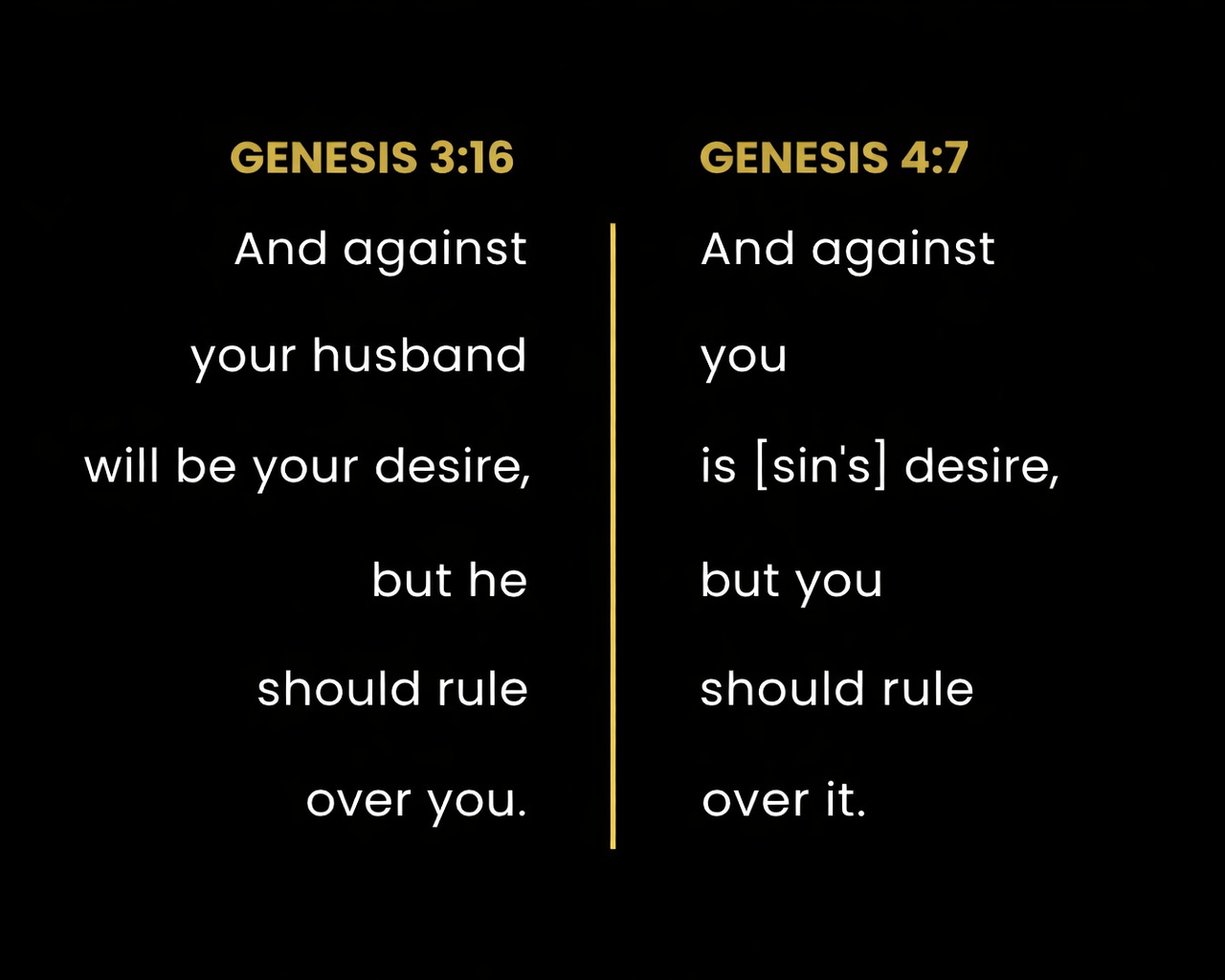
The parallels between Genesis 3:16 and Genesis 4:7 are among the most striking linguistic connections in the Hebrew Bible, as they use virtually identical sentence structures and rare vocabulary to describe two very different situations.
Genesis 3:16 in particular introduces relational tension within marriage. When it says, “Your desire will be for your husband, and he will rule over you,” the language points to a distortion of the partnership originally designed in creation. The word translated “desire” carries the sense of turning against or seeking to control—an idea echoed in Genesis 4:7, where sin’s “desire” is described as crouching at the door, seeking to overtake. In the same way, the woman’s desire in the context of the fall reflects a tendency toward resistance, opposition, or striving against her husband rather than alongside him. Likewise, the phrase “he will rule over you” reflects not loving leadership but a bent toward domination or control. Together, these reveal a relational dynamic distorted by sin where the wife may move toward resistance or antagonism, and the husband toward either passive withdrawal—like Adam in the garden, who stood by silently and then shifted blame—or toward harsh domination. These are corruptions of the original design that fracture unity and turn partners into opponents rather than co-laborers in cultivation.
Reversing the Curse
None of our marriages are immune to the distortions introduced by sin. We have all experienced them to varying degrees—sometimes in brief moments, other times through long and difficult seasons. Instead of working together in the shared calling of cultivation, husbands and wives can easily begin working against one another.
At times it can even feel as though something is actively working against the relationship itself—pushing us toward disconnection, distrust, discouragement, and division. In many ways, that is exactly what is happening. Because of sin, the very things we work to cultivate—life, health, and flourishing—are opposed by the forces of brokenness still present in the world and working against us.
Left to our own instincts, these distortions tend to show up in predictable ways within marriage. Wives may drift toward opposition or resistance, while husbands may respond with passivity (i.e. Adam passively present then blame shifting after Eve partook of the fruit) or attempts to dominate. These patterns mirror the relational tension introduced in Genesis 3 and continue to echo in marriages today, reminding us that the world is not as it was meant to be.
But the gospel offers a different vision.
In Ephesians 5, the apostle Paul connects the work of Christ on our behalf with the way husbands and wives are called to relate to one another. Rather than turning against each other, marriage becomes a partnership in which husband and wife work together against the very forces that are working against them.
Ephesians 5:22–28
Wives, submit yourselves to your own husbands as you do to the Lord. For the husband is the head of the wife as Christ is the head of the church, his body, of which he is the Savior. Now as the church submits to Christ, so also wives should submit to their husbands in everything.
Husbands, love your wives, just as Christ loved the church and gave himself up for her to make her holy… In this same way, husbands ought to love their wives as their own bodies. He who loves his wife loves himself.
Through the gospel, the distortions introduced by the curse begin to be reversed.
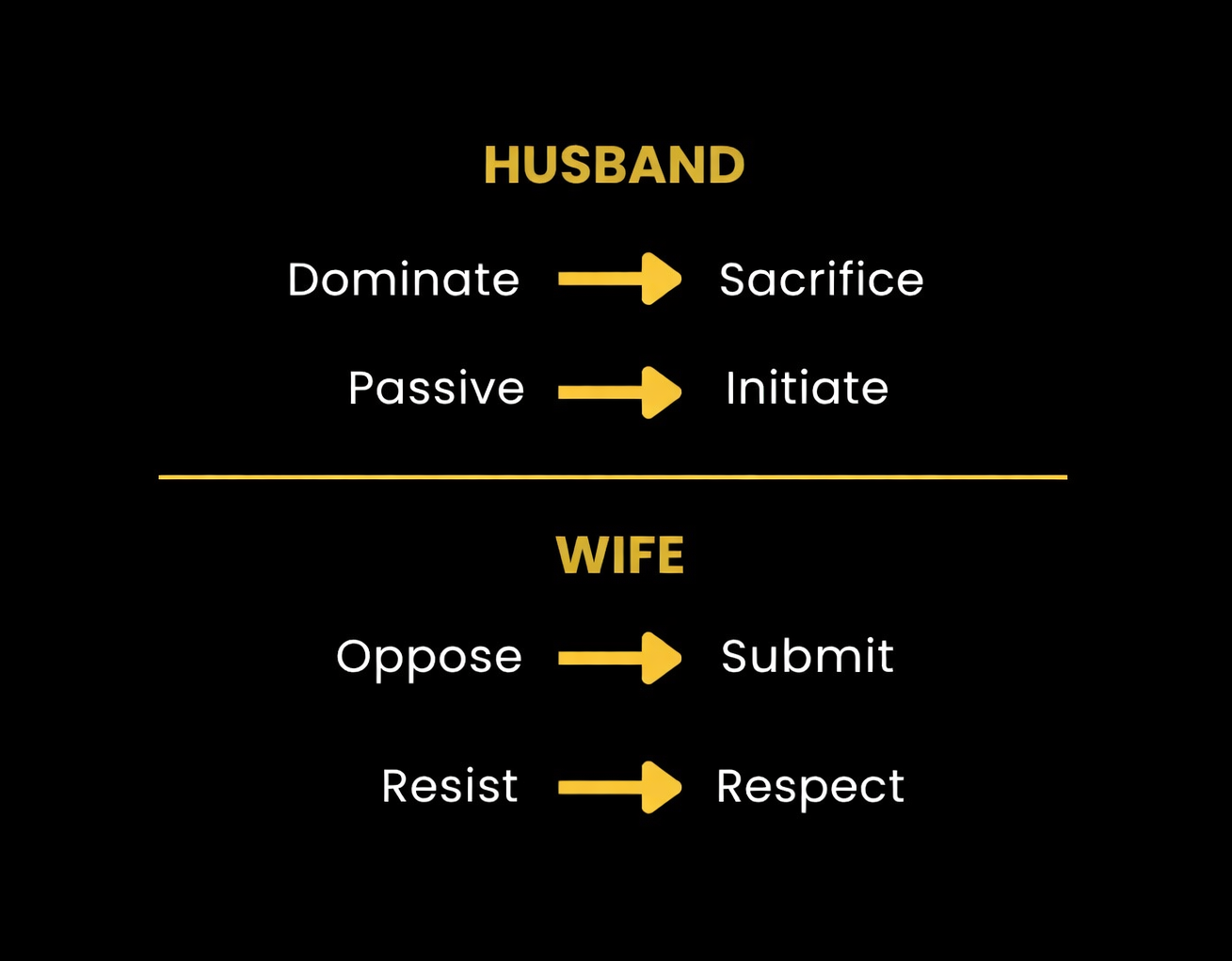
For men, the curse often shows up as either passivity—failing to lead and engage—or domination, seeking control rather than partnership. The gospel calls husbands away from both of these distortions toward intentionality and sacrifice. Just as Christ gave Himself for the church, husbands are called to love their wives with self-giving devotion and care.
For women, the curse often manifests as opposition or resistance toward their husbands. The gospel invites wives to move toward respect, partnership, and willing submission, reflecting the church’s response to Christ.
In this way, the gospel reshapes marriage. Instead of husband and wife opposing one another, they begin to stand side by side—actively working together against the broken patterns that once worked against them.
Left to ourselves, sin pulls us toward opposition, resistance, passivity, and dominance. But as we increasingly lean into the gospel together and allow the life of God to shape our marriage, something different begins to emerge. Marriage becomes a place where submission and respect, intentionality and sacrifice begin to replace conflict and control.
This is the beauty of God’s design for marriage. This is a flourishing marriage - not always easy - but always growing and being formed into the image of Christ reflected through our postures and dispositions of love and sacrifice and respect for one another. This is the
Life with God is the best life. And life with God together as husband and wife is even better!
Demolition Often Precedes Cultivation
Cultivation is difficult, and growth often requires demolition before renewal can occur. Controlled forest burns produce more fertile ground. Intense training breaks down muscle to build strength. Renovations begin by tearing out what no longer works. In the same way, the work of destruction often precedes restoration and growth.
This pattern is consistent throughout the teachings of Jesus and the New Testament. Jesus calls His followers to deny themselves and take up their cross (Matthew 16:24–25). Paul instructs believers to put off the old self and put on the new (Ephesians 4:22–24), and to live lives shaped by Christ’s sacrifice (Galatians 2:20). Even trials become instruments of transformation, producing perseverance and maturity (James 1:2–4). Deny. Lose. Put off. Sacrifice. Endure. These all come before fruit, formation, and flourishing.
This principle is woven into the created order: for new life to grow, old things must die. That reality invites regular reflection on what in our lives—and in our marriages—must be removed to make room for what God desires to grow. This may include unhealthy mindsets, patterns of behavior, lingering hurts, misplaced beliefs, unmet expectations, or unresolved frustration and shame. Left unaddressed, these things quietly work against our ability to experience intimacy, connection, mutual respect, and love.
Cultivation, then, is not only something we were created for—it is something we must continually choose. It requires confronting what is broken so that something better can grow in its place. Yet in Christ, even the most difficult places can be redeemed. As individuals and couples embrace the work of cultivation—within their marriage, their family, and their care for vulnerable children—they participate in God’s redemptive work of bringing life out of brokenness.
Because this is the heart of the gospel: God’s ability to bring beauty from what is broken.